Spilanthes: A “Natural Botox Alternative”?
When it Comes to Looking Youthful, There's Nothing Like the Natural Beauty of a Spilanthes-Powered Skin Care Routine.
Originally published February 23, 2022. Substantially updated July 2026.
When it comes to maintaining healthy-looking, youthful skin, there always seems to be another miracle ingredient promising dramatic results. Every so often, however, a plant comes along that is interesting enough without exaggerated promises.
For us, that plant is Spilanthes.
We have been buzzing about Spilanthes at High Thyme FARMacy since long before it became the key ingredient in our Fountain of Youth skincare collection. When this article was originally published in 2022, Spilanthes was still relatively unfamiliar to many American skincare customers. It remains far less recognizable than ingredients such as retinol, hyaluronic acid, or vitamin C, but interest in this unusual plant continues to grow.
Spilanthes is frequently called the “Botox plant” or promoted as a “natural Botox alternative.” Those descriptions certainly attract attention, but what do they actually mean? Is Spilanthes really comparable to an injectable medical treatment - or is that simply clever cosmetic marketing?
The real story is more nuanced and, we believe, far more fascinating.
What Is Spilanthes?
The plant we grow is botanically known as Acmella oleracea. It belongs to the Asteraceae family, making it a relative of daisies and sunflowers. The accepted botanical name is Acmella oleracea, although Spilanthes remains its most familiar name in herbalism and the cosmetic industry. Older articles, product descriptions, and scientific literature may also refer to related names such as Spilanthes oleracea or Spilanthes acmella.
Its many common names include:
- Spilanthes
- Paracress
- Toothache plant
- Buzz buttons
- Electric daisy
- Electric buttons
- Eyeball plant
- Jambu
- Botox plant
Kew’s Plants of the World Online describes Acmella oleracea as a cultivated plant associated with southeastern Brazil. It is now grown and used in many parts of the world for food, traditional herbal preparations, and other applications.
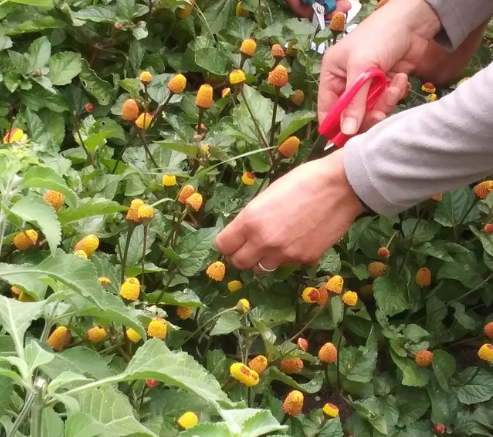
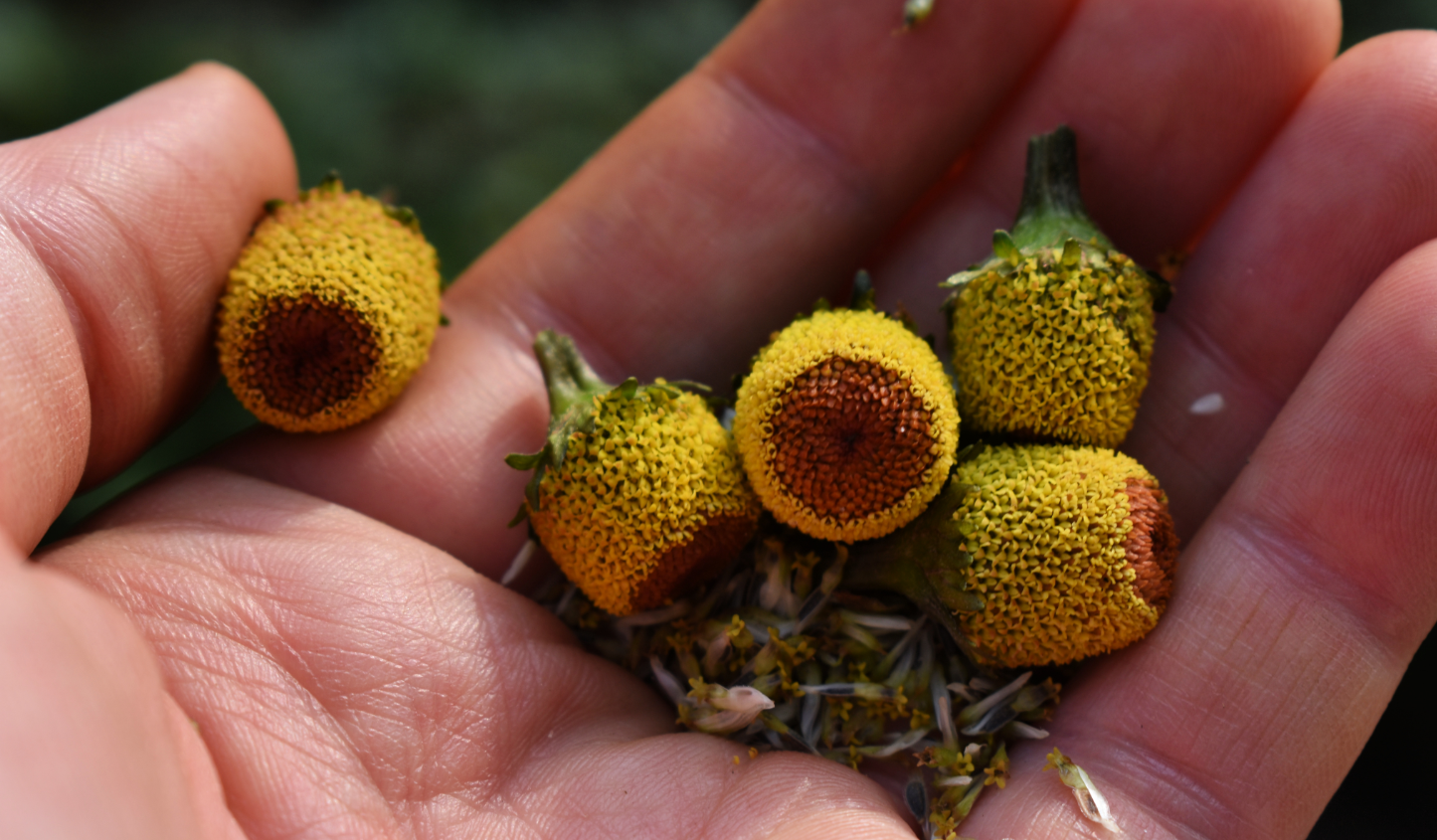
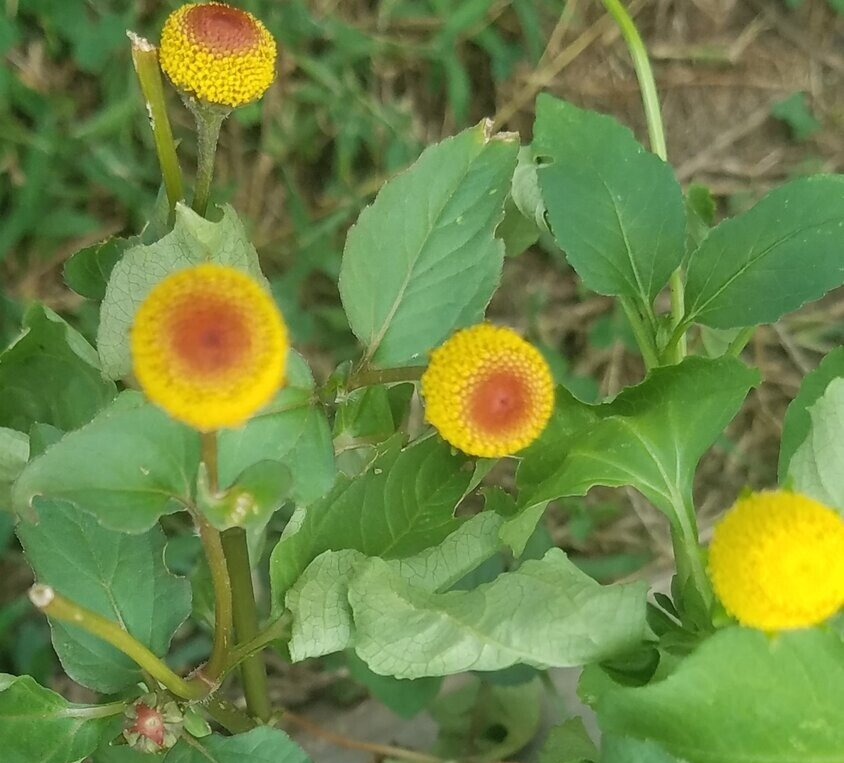
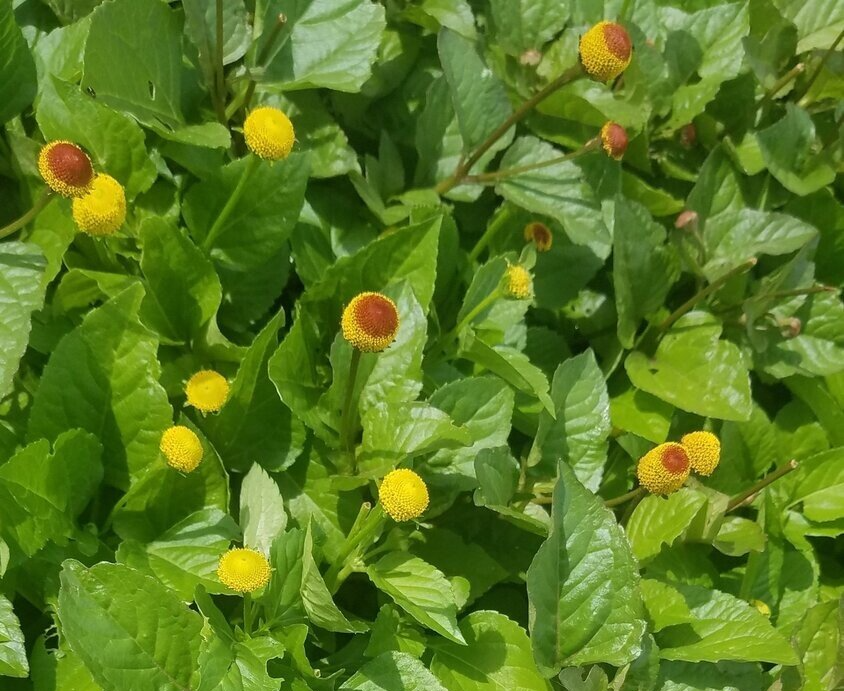
The plant produces small, rounded flower heads that are primarily golden yellow, often with a deep reddish-brown center. Their unusual appearance helps explain names such as “eyeball plant” and “electric daisy.”
Both the leaves and flowers are edible. The flavor is difficult to describe until you experience it: green, grassy, peppery, slightly spicy... and then suddenly electric.
Why Is It Called the Toothache Plant?
We originally began growing Spilanthes because of its traditional herbal uses, particularly the remarkable sensation produced by chewing one of its flower heads.
It quickly became our favorite plant to introduce to visitors.
A small nibble of a fresh Spilanthes flower can create a powerful tingling or buzzing sensation across the tongue and mouth. It may be followed by temporary numbness, warmth, a cooling sensation, and a considerable increase in saliva.
The experience is memorable, to say the least.
This unusual sensory effect is associated primarily with a group of compounds called alkylamides, particularly the compound spilanthol. Spilanthol has been the subject of research involving sensation, pain pathways, inflammation, oral care, extraction methods, and cosmetic applications.
The plant’s temporary mouth-numbing effect contributed to its long-standing reputation as the “toothache plant.” Various cultures have traditionally chewed the flowers or used preparations made from the plant for oral discomfort.
That traditional history does not mean Spilanthes corrects the underlying cause of a toothache. Dental pain can signal infection, injury, or another condition requiring professional care. The nickname reflects how the plant has historically been used - not a recommendation to replace dental treatment.
Spilanthes Is More Than a Novelty Plant
The buzzing sensation may be the plant’s most immediately noticeable characteristic, but Spilanthes has a much broader history.
Different species and preparations associated with Spilanthes and Acmella have been used traditionally for oral care, food, digestive preparations, topical applications, and numerous other purposes. Researchers have investigated possible analgesic, anti-inflammatory, antioxidant, antimicrobial, insecticidal, and other biological activities.
However, it is important to distinguish among:
- Traditional herbal use
- Laboratory research
- Animal studies
- Human clinical studies
- Isolated spilanthol
- Standardized commercial extracts
- Whole-plant preparations
- Finished cosmetic formulas
These are not interchangeable forms of evidence.
A laboratory study involving an isolated compound does not prove that a handmade face oil will have the same activity. Similarly, results obtained with a concentrated alcohol or glycol extract cannot automatically be applied to a traditional oil infusion.
Much of the published research surrounding Spilanthes remains preliminary. It helps researchers understand the plant and identify areas worthy of further investigation, but it should not be interpreted as proof that Spilanthes treats a medical condition.
Why Is Spilanthes Called the “Botox Plant”?
The “Botox plant” nickname is connected to research involving certain standardized Acmella oleracea extracts and their potential effects on facial-expression lines.
Facial expressions require repeated muscle movement. Over time, expressions such as smiling, squinting, concentrating, and frowning contribute to the development of visible lines around the eyes, mouth, and forehead.
Spilanthol and Spilanthes-derived cosmetic extracts have attracted attention because laboratory and cosmetic-industry research has explored their interaction with processes involved in muscle contraction. This has led some ingredient manufacturers and skincare companies to describe Spilanthes as having a relaxing or smoothing effect on the appearance of expression lines.
That is how Spilanthes acquired its dramatic cosmetic nickname.
But Spilanthes is not Botox.
Botox is a brand name associated with an injectable prescription product containing botulinum toxin. It is administered into targeted muscles by a qualified medical professional.
Spilanthes is a botanical ingredient applied to the surface of the skin. It is not injected, does not contain botulinum toxin, and should not be expected to produce the same mechanism or results as a medical injection.
Calling Spilanthes a “natural Botox alternative” is best understood as shorthand for its use in botanical skincare formulated to help skin look smoother, firmer, and more refreshed. It should not be interpreted as proof that Spilanthes duplicates or replaces Botox.
What Does the Cosmetic Research Show?
The cosmetic research is promising, but it must be described accurately.
A peer-reviewed study published in 2021 evaluated a finished facial serum containing an Acmella oleracea extract. After two weeks of use, researchers reported improvements in measured wrinkle characteristics around the eyes and mouth.
Importantly, this study tested a particular finished serum, not raw Spilanthes, every Spilanthes extract, or High Thyme FARMacy’s oil infusion. It also did not compare the product directly with Botox.
A preliminary study published in 2025 examined another glycolipid-based serum containing Acmella oleracea extract. Researchers reported good skin tolerability along with improvements in hydration and skin-surface measurements. Again, those findings apply to the specific formulation studied.
Other cosmetic studies have examined formulas combining Acmella oleracea extract with ingredients such as retinol. Because multiple active ingredients were used, the results cannot be attributed exclusively to Spilanthes.
Together, these studies suggest that Acmella oleracea is a legitimate subject of cosmetic research. They do not establish that every Spilanthes product works the same way, nor do they prove that a botanical skincare product is equivalent to Botox.
What About Collagen, Antioxidants, and Inflammation?
Spilanthes and spilanthol have also been investigated for antioxidant and anti-inflammatory activity. Researchers continue to explore how these properties may relate to traditional uses and future topical applications.
You may also encounter articles claiming that Spilanthes “rebuilds collagen,” “increases collagen by 92%,” or dramatically reduces inflammation.
Those claims require context.
Some research has examined collagen-related effects in specialized laboratory or animal models, including studies involving tissue other than facial skin. Results from those models do not prove that applying a Spilanthes face oil increases collagen production in human facial skin.
The FDA also distinguishes between cosmetic claims about improving appearance and drug claims suggesting that a product changes the structure or function of the skin. Claims that a cosmetic stimulates collagen, alters muscle function, treats inflammation, prevents acne, or kills infection-causing bacteria may cause the product to be regulated as a drug.
For that reason, we prefer accurate cosmetic language.
We formulate our Fountain of Youth products to:
- Moisturize and condition the skin
- Help skin feel softer and smoother
- Improve the appearance of dryness
- Support a healthy-looking complexion
- Help soften the visible appearance of fine lines
- Leave mature skin looking nourished and refreshed
Those are meaningful skincare benefits without presenting a botanical cosmetic as a medical treatment.
Our Farm-Grown Approach to Spilanthes
Spilanthes is not merely an ingredient name printed on a supplier’s label for High Thyme FARMacy.
We grow it.
Our relationship with the plant begins with seeds and soil. We tend the plants, watch the first flower heads form, harvest the leaves and buttons, carefully dehydrate the plant material, and prepare our own whole-herb oil infusions in small batches.
Growing Spilanthes ourselves gives us direct control over:
- The identity of the plant
- How it is grown
- When it is harvested
- How the flowers and leaves are handled
- How the plant material is dried and stored
- What enters our infusions and finished skincare
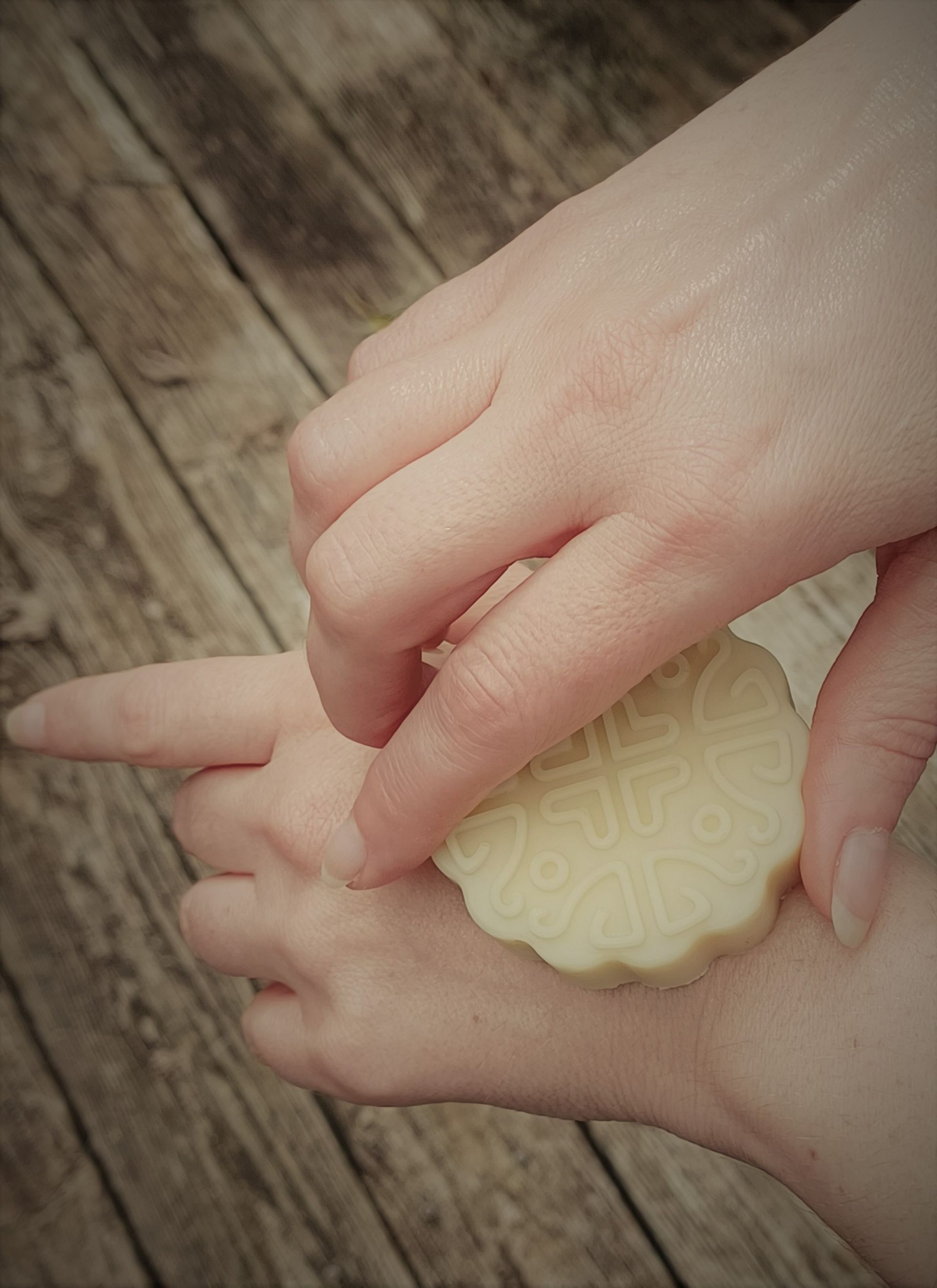
Our Fountain of Youth Firming Face Oil is made with botanical carrier oils infused with farm-grown Spilanthes and complementary herbs. It is not the same material used in studies of standardized commercial extracts, and we do not represent it as though it has undergone those clinical studies.
Instead, our approach brings together traditional whole-herb infusion, thoughtful cosmetic formulation, personal experience with the plant, and a continually growing respect for the science surrounding it.
Fresh Spilanthes Versus Dried Spilanthes
When this article was first published in 2022, our process and understanding were still evolving.
We now carefully dry our harvested Spilanthes before using it in oil infusions. Removing moisture is an important step when plant material will be infused into an oil-based cosmetic because water can introduce stability and preservation concerns.
Drying does not make the plant meaningless or inactive. Researchers successfully extract spilanthol and other constituents from dried Acmella oleracea flower heads, although the amount extracted depends on variables such as plant part, storage, temperature, solvent, extraction time, and method.
A dried whole-herb oil infusion is still different from the concentrated ethanol, glycol, or laboratory extracts used in many studies. That distinction is one we will explore throughout our Spilanthes Research Library.
Is Spilanthes a Natural Botox Alternative?
Our answer today is more careful than it was when we first wrote this article in 2022.
Spilanthes is not a natural version of Botox, nor has it been proven to provide results equivalent to Botox injections.
It is, however, a fascinating botanical ingredient with:
- A long history of traditional use
- A completely distinctive sensory effect
- A growing body of scientific research
- Several compounds of interest, particularly spilanthol
- Promising early research involving specific cosmetic extracts and formulas
- Considerable potential in skincare designed to improve the appearance of mature skin
For someone seeking a gentle, noninvasive botanical skincare ritual rather than an injectable procedure, Spilanthes may be a compelling ingredient to explore. That is a more accurate meaning of the phrase “natural Botox alternative.”
It describes an alternative approach to caring for the appearance of aging skin - not an identical replacement for a medical procedure.
The Beginning of Our Spilanthes Journey
This was the first Spilanthes article published by High Thyme FARMacy. Although our knowledge, processes, product collection, and language have evolved since February 2022, we do not want to erase where the journey began.
Spilanthes inspired us then, and it inspires us even more today.
It is an edible plant, a traditional toothache herb, a source of unusual alkylamides, a subject of modern scientific research, and the heart of our Fountain of Youth skincare collection.
Most importantly, it is a plant we personally grow, harvest, dry, infuse, formulate with, and continue to study.
Our expanding Spilanthes & Paracress Research Library will explore:
- The botanical identity of Acmella oleracea
- Spilanthol and the plant’s famous tingling sensation
- Fresh versus dried Spilanthes
- Flowers, leaves, stems, and other plant parts
- Traditional uses around the world
- Oral-care and toothache traditions
- Cosmetic and skincare research
- Antioxidant, antimicrobial, and anti-inflammatory studies
- Growing and harvesting Spilanthes
- Extraction and infusion methods
- Safety and responsible use
- The important differences between traditional use, laboratory findings, and human clinical evidence
Spilanthes does not need to be presented as a miracle plant or an herbal version of an injectable drug to deserve attention.
The truth about this extraordinary little flower is interesting enough.
Important Note
This article is provided for historical and educational purposes and is not intended to diagnose, treat, cure, or prevent any disease. High Thyme FARMacy’s Fountain of Youth products are cosmetics intended to cleanse, moisturize, condition, and improve the appearance of the skin. Individual experiences and sensitivities vary. Patch testing is recommended before using a new topical product.
Share
A High Thyme FARMacy Blog