Why Does Spilanthes Make Your Mouth Tingle? The Science of Spilanthol
Inside the buzz, numbness, mouth-watering effect, and fascinating chemistry of the toothache plant we grow here at High Thyme FARMacy.
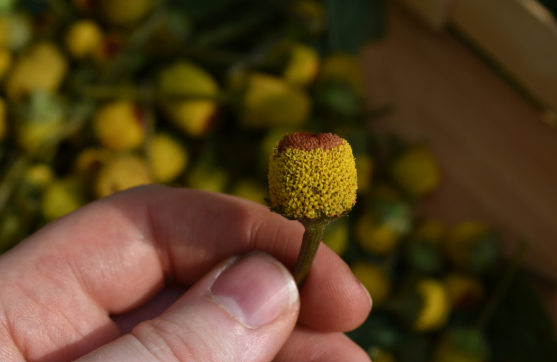
Few plants introduce themselves quite as dramatically as Spilanthes.
Here at High Thyme FARMacy, we have introduced quite a few friends and visitors to their first fresh Spilanthes flower. We usually give them a small flower, tell them to chew it, and then wait for the reaction.
First comes the buzz.
Within seconds, the tongue begins tingling and the sensation spreads across the mouth. People have described it to us as electric, fizzy, peppery, warm, cool, prickly, and slightly numbing... sometimes all at once. Many say it tastes like grass.
Then their salivary glands seem to switch into overdrive.
Every single person we have invited to try a fresh Spilanthes flower has commented on how much it makes their mouth water. The exact character of the buzz may differ from one person to another, but the rush of saliva has been consistent. It is usually the part they are least prepared for and one of the things they talk about most afterward.
Spilanthes does not simply tingle a little. It creates a full-mouth experience: buzzing, tingling, temporary numbness, changing sensations, and an astonishing amount of salivation.
That unforgettable reaction has earned Acmella oleracea several fitting names, including:
- Buzz buttons
- Electric daisy
- Toothache plant
- Paracress
- Jambu
- Eyeball plant
- Szechuan buttons
But what actually causes the famous Spilanthes buzz?
The compound most closely associated with it is called spilanthol.
First, What Is Spilanthes?
The plant we grow here at High Thyme FARMacy is botanically known as Acmella oleracea. It is an annual member of the Asteraceae family, which also includes daisies and sunflowers.
Although Acmella oleracea is its accepted botanical name, Spilanthes remains one of the names most commonly used by gardeners, herbalists, cosmetic companies, and customers. Older botanical references may also identify it by names such as Spilanthes oleracea or Spilanthes acmella.
Kew’s Plants of the World Online recognizes Acmella oleracea as the accepted name for the plant and associates it with southeastern Brazil, where it is well known as jambu.
Here at High Thyme, we generally call it Spilanthes because that is the name by which we first came to know and love it. When botanical precision matters, however, we identify the plant we grow as Acmella oleracea.
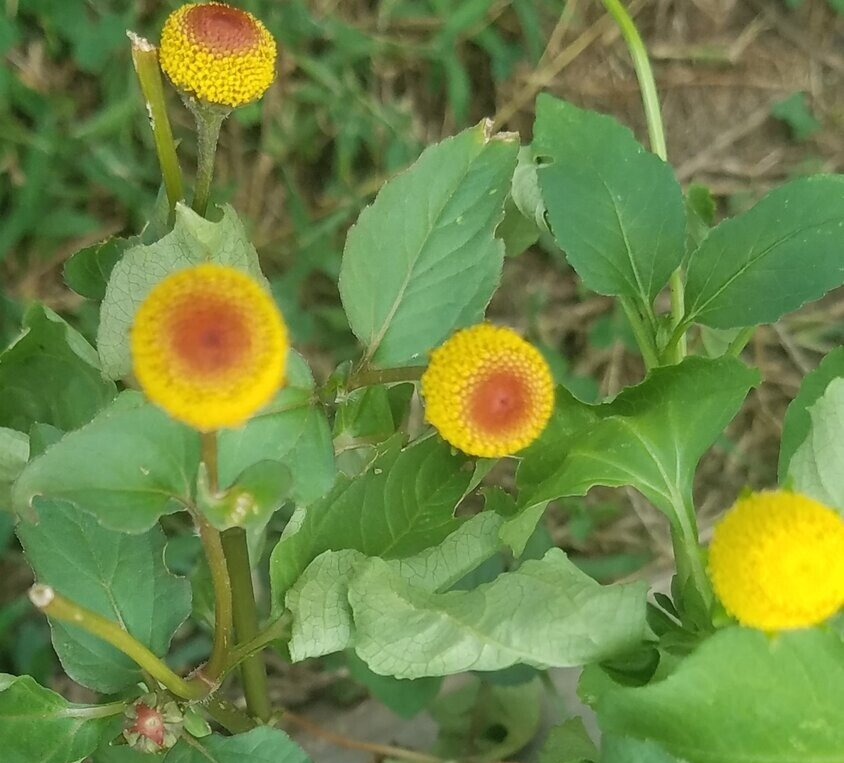
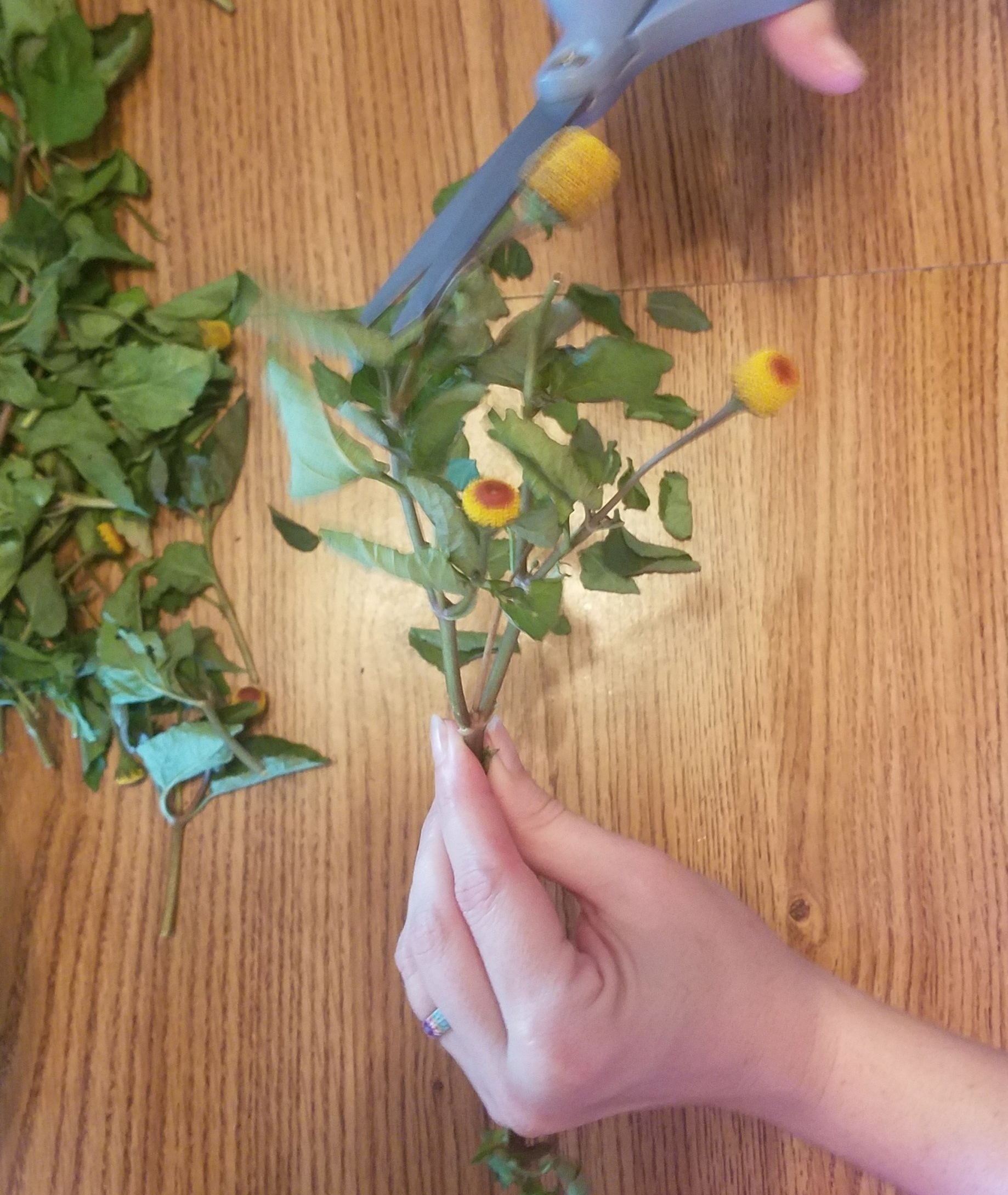
The plant produces small, rounded golden flower heads, often with a deep reddish center. They are cheerful, unusual, and almost eyeball-like, but their appearance gives no warning of the experience waiting inside.
What Is Spilanthol?
Spilanthol is a naturally occurring compound belonging to a larger group known as N-alkylamides.
It is the best-known compound associated with the distinctive sensory effects of Spilanthes. Spilanthol and related alkylamides contribute to the plant’s pungency, tingling, temporary numbness, and saliva-stimulating effects.
Scientists have isolated several taste-active compounds from Spilanthes flower heads, with spilanthol considered one of the most important contributors to the characteristic buzz.
Spilanthol is not the only interesting compound in the plant, and it should not be treated as though it represents everything Spilanthes contains or does.
Still, when someone asks us why one tiny flower made their entire mouth feel electric, spilanthol is the best place to begin.
Why Does Spilanthes Feel Electric?
Spilanthes does more than create a flavor. It produces what researchers call a chemesthetic sensation.
Chemesthesis refers to physical sensations that occur when compounds interact with sensory nerve pathways in the mouth and elsewhere in the body. These sensations are different from the basic tastes of sweet, salty, sour, bitter, and savory.
Other familiar examples include:
- The heat of chili peppers
- The cooling feeling of menthol
- The sharpness of mustard
- The prickling sensation of carbonation
The alkylamides in Spilanthes appear to interact with sensory pathways involved in irritation, heat, discomfort, and pain perception. Researchers have investigated several possible mechanisms, including activity involving TRPV1 and cannabinoid-related receptors. The effects can vary with the compound, concentration, preparation, and biological model being studied.
That may help explain why the Spilanthes experience is so difficult to describe.
It is not simply hot. It is not simply cold. It is not exactly painful, although an overly large bite can become intense.
It does not feel quite like the numbness from a dental anesthetic, either.
For many people, it feels like several sensations arriving at once.
That is part of what makes it so much fun for us to grow and share.
Why Does the Spilanthes Buzz Make Your Mouth Water So Much?
The buzz and the mouth-watering effect are not two separate experiences. They begin together and build quickly.
When someone chews a fresh Spilanthes flower, the first thing they usually notice is the tingling. That sensation may begin on the tongue and spread toward the lips, gums, cheeks, or roof of the mouth.
Almost immediately, saliva production increases... sometimes dramatically.
Here at High Thyme FARMacy, every person we have invited to try a flower has mentioned how much it makes their mouth water. Some loved the buzz. Some thought it was strange. Some laughed through the entire experience, while others looked at us as though we had played a trick on them.
But they all noticed the same thing: their mouths suddenly filled with saliva.
We warn people beforehand, but they rarely understand what we mean until it happens. It is not merely the mild mouth-watering that may occur when tasting something sour or spicy. For many people, it feels as though their salivary glands have suddenly been turned all the way up.
The saliva-stimulating effect of Spilanthes has long been recognized in traditional-use literature. Scientific reviews also identify increased salivary secretion as one of the plant’s characteristic oral effects.
That salivation is not insignificant. Saliva helps moisten and protect oral tissues, wash away food particles, support swallowing and taste, neutralize acids, and help protect the teeth and mouth.
Spilanthes does not simply add a new flavor to something. It temporarily changes the environment inside your mouth.
The buzzing, tingling, temporary numbness, and rush of saliva combine to create the unmistakable Spilanthes experience.
Does Spilanthes Change the Way Food and Drinks Taste?
It certainly can.
Saliva plays an important role in taste because it helps dissolve and distribute flavor compounds across the mouth. When Spilanthes suddenly increases saliva while creating tingling and altered sensation across the tongue, familiar flavors can seem brighter, sharper, stronger, or simply different.
One of the best-known examples is the Verbena, the famous off-menu cocktail associated with The Chandelier inside The Cosmopolitan of Las Vegas.
The best-known version of the Verbena is made with tequila, citrus, ginger, and lemon verbena and served with an edible Spilanthes flower commonly called a Szechuan button or buzz button. Guests are instructed to take a sip of the cocktail first to taste the initial citrus and tart flavor profile, then eat the flower and chew it well for about 20 seconds.The spilanthol causes your mouth to tingle, go numb, and produce a rush of saliva. You take another sip of the drink and the numbing effect alters your taste buds and makes the cocktail taste noticeably sweeter and smoother, and makes the flavors of the drink seem dramatically intensified, overall.
It is a nearly perfect demonstration of what Spilanthes can do to the tasting experience.
Mike and I have even made our own copycat version of the famous Verbena here at home. We used our own fresh Spilanthes flowers, of course. We will save that recipe and our experience making it for another blog article.
Does Everyone Experience Spilanthes the Same Way?
Not at all.
Some people feel an intense electric buzz after the smallest nibble. Others describe the sensation as more peppery, fizzy, warm, cool, or numbing.
The exact character and intensity of the buzz can vary, but in our experience here at High Thyme, the mouth-watering response has been universal. Every participant has remarked on how strongly and quickly the flower stimulates saliva.
Several factors may influence the experience:
- The size of the bite
- The person’s individual sensitivity
- The maturity of the flower
- Plant genetics
- Growing conditions
- Time of harvest
- Which plant part is used
- Fresh versus dried plant material
- Storage conditions
- Extraction method
- The concentration of alkylamides
Plants are living materials. Their natural chemical profiles can vary with genetics, maturity, weather, soil, handling, harvesting, drying, and storage.
Not every flower from every harvest will feel completely identical. That does not mean anything is wrong with the plant. It means an herb is not an identical synthetic ingredient manufactured to one exact concentration.
Do the Leaves Tingle Too?
Yes, the leaves can also create a noticeable sensation.
Both the leaves and flower heads are edible, and both contain valuable plant compounds. However, the experience is not always the same.
In our experience here at High Thyme FARMacy, mature flower heads generally provide the strongest and most recognizable buzz. The leaves can be peppery and tingly, but the sensation may be milder or simply different.
Different parts of Acmella oleracea also have different chemical profiles. Flowers are especially associated with pungent alkylamides such as spilanthol, while leaves may supply greater amounts of some phenolic and flavonoid compounds.
That is one reason we value more than one part of the plant.
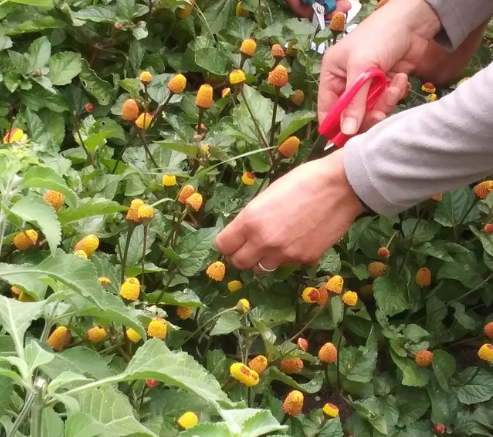
When we harvest here at High Thyme, we collect both Spilanthes buttons and leaves. We carefully dehydrate them and use the plant material in our whole-herb infusions.
Why Is It Called the Toothache Plant?
Spilanthes earned the name toothache plant because of its long history of traditional oral use.
The temporary tingling and numbing sensation is the most obvious reason for the nickname, but we do not believe that is the whole story.
The saliva matters, too
As we have already discussed, Spilanthes can produce a remarkable increase in saliva. Adequate saliva helps keep the mouth moist, supports swallowing, washes away debris, buffers acids, and contributes to the mouth’s natural defenses.
For someone experiencing a dry, irritated, or uncomfortable mouth or throat, that sudden moisture can feel every bit as noticeable as the temporary numbing sensation.
Researchers are studying more than numbness
Spilanthes and its extracts have also been investigated for anti-inflammatory and antimicrobial activity.
Laboratory research has found antibacterial activity against several microorganisms, including bacteria associated with oral disease. However, a recent systematic review emphasized that most antibacterial evidence remains laboratory-based and that clinical research is still limited.
A pilot laboratory study also found that a particular Spilanthes tincture reduced bacteria collected from human saliva under the study’s test conditions. That does not prove that every Spilanthes preparation disinfects the mouth or treats an oral infection, but it helps explain why researchers continue to study the plant for oral-care applications.
One small clinical study evaluated a specially prepared 1% Acmella oleracea gel as an addition to professional periodontal treatment. Several clinical measurements improved, although the microbiological reduction was not statistically significant.
Our own experience with a personal mouth-and-throat spray
Here at High Thyme, Lynnette makes a Spilanthes mouth-and-throat spray strictly for personal and family use.
She and several other people who have tried this personal preparation prefer the overall experience to a conventional numbing gel such as Orajel. For them, it is not merely about making one small spot feel numb. They appreciate the combination of the buzz, temporary numbing sensation, flood of saliva, and herbal character of the complete preparation.
We also value the fact that Spilanthes is being studied for anti-inflammatory and antibacterial activity rather than viewing it solely as a numbing novelty.
That said, this is our personal experience - not a clinical claim, a product recommendation, or proof that a homemade preparation treats toothaches, throat infections, gum disease, or any other condition.
Is the Tingling the Same as Pain Relief?
Not necessarily.
Researchers have studied alkylamide-rich extracts from Acmella oleracea in experimental models involving pain and sensory pathways. Some findings suggest antinociceptive or pain-modulating activity under particular conditions, while other concentrations or pathways may provoke sensation instead.
In simpler terms, the same family of compounds can produce complicated effects depending on the concentration, preparation, location, and biological system involved.
That matches the real-world experience surprisingly well.
Spilanthes may feel numbing, but it also tingles. It may feel comforting to one person and overwhelmingly intense to another.
Here at High Thyme, we never assume that feeling a strong physical sensation automatically proves a therapeutic result.
Feeling something and treating something are not the same.
Does Dried Spilanthes Still Tingle?
It can, although the experience may differ from eating a freshly harvested flower.
Freshness, drying temperature, storage time, plant part, and extraction method can all influence the amount and profile of spilanthol and related alkylamides recovered from plant material. Researchers routinely work with dried Acmella oleracea, but the resulting concentration depends heavily on how the material is processed and extracted.
Here at High Thyme FARMacy, we carefully dehydrate our harvested flowers and leaves before using them in oil infusions.
Fresh plants contain water. Introducing fresh botanical material into an oil-based cosmetic can create stability and microbial-safety concerns, so thoroughly drying our Spilanthes is an important part of our current process.
Dried Spilanthes is not dead, useless, or stripped of everything valuable. It remains useful botanical material, but it is not identical to a fresh flower.
This subject deserves an article of its own because there is much more to explore about harvesting, dehydrating, storage, extraction, and how each step may influence the finished preparation.
Does a Spilanthes Skincare Product Have to Tingle?
No.
A fresh flower chewed directly in the mouth is very different from a properly formulated facial product.
The amount and type of sensation created by a finished product can depend on:
- The form of Spilanthes used
- Which plant parts were included
- The extraction method
- The concentration
- The rest of the formula
- How much product is applied
- Where it is applied
- The individual person’s skin sensitivity
A standardized alcohol or glycol extract is chemically different from an infused oil. Isolated spilanthol is different from the whole plant. A face cream is different from chewing a fresh flower.
Some customers notice a mild sensation when using genuine Spilanthes skincare, while others notice very little. Neither response automatically determines whether the rest of the formula is effectively moisturizing, conditioning, and softening the skin.
Does More Tingling Mean a Better Product?
No.
We understand why people make that connection. Spilanthes is famous for its buzz, so it is natural to assume that the strongest-tingling product must contain the most Spilanthes or work the best.
The reality is more complicated.
A stronger sensation could reflect a higher concentration of certain sensory compounds, but it could also reflect the extraction method, the type of formula, the amount applied, another ingredient, or the customer’s sensitivity.
Stronger does not automatically mean safer, gentler, better formulated, or more effective as skincare.
Here at High Thyme FARMacy, we formulate Fountain of Youth as a complete skincare ritual, not as a contest to produce the strongest possible tingle.
We want our products to moisturize, condition, soften, and help improve the visible appearance of mature skin.
Spilanthes is at the heart of the collection, but it works within carefully chosen combinations of botanical oils, herbs, butters, hydrosols, and other cosmetic ingredients.
Buyer Beware: Not Everything Called “Paracress Oil” Contains Paracress
As interest in Spilanthes and paracress grows, more products are appearing online with words such as:
- Paracress oil
- Spilanthes serum
- Botox plant oil
- Natural Botox serum
- Buzz button extract
A name on the front of a bottle does not necessarily tell you what is inside it.
We have personally come across products marketed prominently as “paracress” products where, once we finally found the full ingredient list, we could not locate Acmella oleracea, Spilanthes, paracress, or a clearly identified Acmella extract anywhere in the formula.
In some listings, finding the ingredients at all is surprisingly difficult.
That is where we believe consumers need to slow down and read carefully.
Cosmetics sold in the United States are generally required to provide an ingredient declaration so shoppers can compare products and make informed decisions.
Look for:
- A complete ingredient list
- The botanical name Acmella oleracea
- A clearly identified Spilanthes or Acmella extract
- An explanation of whether the product uses an extract, infused oil, powder, or another preparation
- Information about where and how the botanical material was obtained
- A company willing to answer reasonable ingredient questions
Also remember that the word oil can be vague. Some of these products use fractionated coconut oil as their primary carrier, while others list little more than “mineral oil.” Cosmetic-grade mineral oil is widely used in skincare and is not automatically an unsafe ingredient. It can be useful for sealing moisture into dry skin. However, it is a petroleum-derived occlusive - not a nutrient-rich botanical oil and certainly not Spilanthes or paracress.
That distinction matters when a product is prominently marketed as “paracress oil.” If you are expecting a botanical facial oil made with genuine Acmella oleracea, you may want to reconsider a formula built primarily around mineral oil, especially when the company does not clearly disclose how much paracress it contains, what type of extract was used, or where that extract came from.
Here at High Thyme FARMacy, we prefer skin-loving botanical carrier oils chosen for their individual fatty-acid profiles, feel, and role within the complete formula. Mineral oil may suit some people perfectly well, but consumers deserve to know whether they are buying a thoughtfully formulated botanical infusion or an inexpensive base oil carrying a marketable name.
“Paracress oil” might mean an oil infused with the actual plant. It might mean a carrier-oil blend containing a small amount of purchased extract. It could also simply be a marketing name attached to a product that contains no clearly disclosed paracress ingredient.
Many businesses do not grow or process Spilanthes themselves. They purchase extracts through ingredient suppliers, and those extracts may be manufactured or sourced internationally, including from China and other countries.
That is not automatically bad. Country of origin alone does not determine whether an ingredient is authentic, safe, or high quality.
The problem is a lack of transparency.
Consumers deserve to know whether a company:
- Grows the plant itself
- Purchases dried plant material
- Buys a standardized commercial extract
- Knows the botanical species
- Knows where the ingredient originated
- Can provide a complete ingredient list
- Can explain what “paracress” means in that particular formula
Price is not absolute proof of quality, but it can be a clue.
Authentic botanical material, careful growing, harvesting, dehydrating, extracting, filtering, testing, packaging, and small-batch production all cost money. When a product makes extraordinary claims, offers very little ingredient information, and is priced far below what careful production would reasonably cost, it is worth asking questions.
As the old saying goes: if something seems too good to be true, it often is.
Not always, but often enough that we read the label.
What Does Spilanthol Have to Do With Skincare?
Spilanthol and standardized extracts made from Acmella oleracea have attracted interest from cosmetic researchers and ingredient developers.
Specific finished serums containing Acmella extracts have been evaluated for their effects on hydration, skin texture, and the visible appearance of facial lines. Those findings belong to the particular extracts and finished formulas studied; they cannot automatically be applied to every product containing Spilanthes.
Our Fountain of Youth products use our own farm-grown, whole-herb Spilanthes infusions. They are not the standardized commercial extracts evaluated in those studies, and we do not claim that our formulas were clinically tested in those trials.
However, unlike many cosmetic formulas that rely on an isolated or standardized paracress extract, our Fountain of Youth Firming Face Oil begins with whole, farm-grown Spilanthes flowers, also known as paracress flowers.
Here at High Thyme FARMacy, we double-infuse our carefully dried flowers into a nourishing blend of Sunflower Oil, Apricot Kernel Oil, and Jojoba Oil, creating a true botanical paracress flower facial oil designed to moisturize, condition, and support healthy, radiant-looking skin. Spilanthol is a lipophilic, or fat-loving, alkylamide, and research has successfully recovered it in nonpolar extracts and spilanthol-rich essential oil. This provides a scientific basis for using an oil infusion to draw oil-soluble constituents from the whole flowers into our carrier oils. Our infusion is not standardized to a particular percentage of spilanthol, but it allows us to formulate with the plant itself rather than simply adding an isolated commercial ingredient to an otherwise ordinary facial oil.
From Seed to Buzz Button Here at High Thyme FARMacy
For us, Spilanthes is much more than the name of an ingredient on a label.
We begin with seeds.
We watch the tiny plants emerge, tend them as they grow, and wait for the first unusual golden buttons to appear.
As the season progresses, we harvest tray after tray of flowers and leaves. We inspect them, dehydrate them, store them carefully, and prepare them for our whole-herb infusions.
We also continue to occasionally taste the fresh flowers, because no matter how many times we experience it, the "Spilanthes buzz" never gets old.
Growing it ourselves has allowed us to know the plant in a way we never could by purchasing a premade extract.
We see how the plants respond to heat, rain, and changes in the growing season. We notice differences among flowers. We know what a fresh harvest looks, smells, and feels like. We know how much time and plant material go into filling tray after tray in the dehydrator.
Most importantly, we continue learning.
The more we study Spilanthes, the more careful we become about separating traditional knowledge, personal experience, laboratory findings, cosmetic research, and claims about finished products.
We do not believe we need to exaggerate this plant to make it interesting.
One tiny flower that can make your entire mouth buzz and your salivary glands go into overdrive is already remarkable enough.
The Buzz Is Only the Beginning
Spilanthes does not simply have a flavor. It creates an experience.
Its combination of tingling, buzzing, salivation, pungency, warmth, cooling, and temporary numbness has fascinated cooks, bartenders, gardeners, herbalists, researchers, cosmetic formulators, and curious visitors around the world.
Spilanthol may be the plant’s most famous compound, but it is only one part of a much larger botanical and chemical story.
Here at High Thyme FARMacy, the famous buzz was one of the first things that drew us to Spilanthes.
Years later, we are still growing it, harvesting it, drying it, infusing it, formulating with it, tasting it, sharing it, and discovering how much more there is to learn.
The tingling may be what first gets someone’s attention.
For us, it was only the beginning.
Important Educational Notice
This article is provided for educational and historical purposes. It is not medical or dental advice and is not intended to diagnose, treat, cure, or prevent any disease.
Research discussed in this article may involve isolated compounds, concentrated extracts, laboratory experiments, animal models, professionally prepared dental materials, or specific finished formulations. Those findings should not automatically be assumed to apply to homemade preparations or High Thyme FARMacy products.
High Thyme FARMacy’s Fountain of Youth products are cosmetics formulated to cleanse, moisturize, condition, and improve the appearance and feel of the skin.
Share
A High Thyme FARMacy Blog